
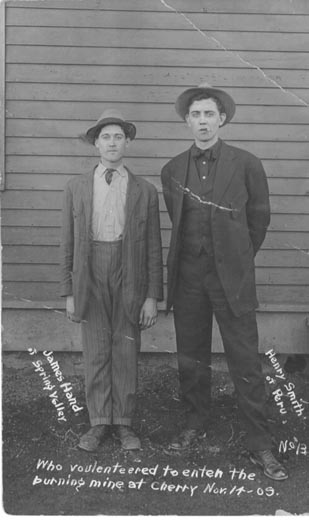
Here's part one of a ten-part YouTube video series on the 1909 Cherry Mine Disaster. This panel discussion was hosted by the Abraham Lincoln Presidential Library and Museum on January 26, 2010.The tragedy resulted in the loss of 259 lives. And as is often the case, those deaths provided the necessary impetus for new safety regulations in the mines.
Here's the link to another site on the disaster. It includes an impressive collection of photos including this one.
The Cherry Mine Disaster is an important event to remember this Labor Day and for many to come.
Sunday, September 5, 2010
Cherry Mine Disaster at the Abraham Lincoln Library

Monday, August 16, 2010
Road To Hell
This past week marks the 78th anniversary of the events which incited the Illinois Mine War.
United Mine Workers District 12 had been on strike in Illinois since April, 1932. On August 6, 1932, a referendum was held to determine whether its members would accept the coal operators proposal - a decline in wages from $6.10/day to $5.00/day. Four days later the ballots were stolen.
 UMWA rallies West Frankfort miners during the strike.
The Nation magazine reported:
"…before the votes could be counted, and in fact while the ballot boxes were being transported…to the district headquarters of the United Mine Workers where they were to be opened and the votes tallied, the boxes were stolen by two armed men.
John L. Lewis, international president, promptly declared that an emergency existed and that under his emergency powers he would have to order the new contract to take effect immediately.
Obviously, nothing was said in the Lewis announcement concerning the fact that ownership of the automobile in which the two thugs were riding had been traced to Fox Hughes, vice-president of the Illinois district of the United Mine Workers and one of Lewis’s henchmen. It is not surprising that a new revolt against the Lewis-Walker leadership is spreading among the Illinois miners, who are continuing the strike despite Lewis’ order."
The Nation, August 24, 1932
This bit of burlesque characterized the feelings of many of Illinois miners at that time:
John L. Lewis blew the whistle;
John H. Walker rang the bell;
Fox Hughes stole the ballots,
and the miners wages went to hell.
John H. Walker rang the bell;
Fox Hughes stole the ballots,
and the miners wages went to hell.
Sunday, July 4, 2010
"It Was A Night To Remember."
The Colonial Theater in Gillespie, IL was often used as a community meeting hall when large numbers needed to assemble.
During the UMWA strike in the spring of 1932, UMWA District 12 President, John Walker came to Gillespie to argue for the wage reductions supported by John L. Lewis and the mine owners.

Photo courtesy of Jill Secoy
Western Illinois University Professor Emeritus, Victor Hicken attended the meeting:
"I was only about 10 and I went there with my mother.
He [John Walker] got about ten minutes into his speech and all of sudden you had these people getting up. And it seems to me that the first fellow to get up was a Scot by the name of Easton. And he tore into Walker. And when he sat down somebody else got up and tore into Walker.
And right in the middle of this, I was sitting there – a hunk of plaster from the ceiling came right down and landed on my lap – just missed my head. It scared the living daylights out of me. But that didn’t interrupt anything.
I mean from that time on Walker I don’t think ever finished his speech. He had to walk off if I remember correctly, he didn’t finish his speech.
It was a night to remember."
This meeting was characteristic of the inability of the UMWA leadership to win rank and file support for the reduced wage. After losing two contract elections, Lewis seized power by declaring an emergency to impose the new contract. Lewis' actions precipitated violence and bloodshed for years to come.
Monday, June 14, 2010
Superior #4 ~ Wilsonville
Here's a photo of Superior #4 in Wilsonville, IL. This was the site of the famous Wilsonville Sitdown Strike. Click here to learn more about the strike and to see a contemporary photo of the site.
 Photo provided courtesy of Wayne Hinton
Monday, June 7, 2010
Hand Crafted From Coal
John L. Lewis, President of the United Mine Workers of America from 1920 - 1960 is still revered among many retired coal miners.

This Lewis bust was sculpted from a lump of coal by Mid-West Crafts in Pikeville, KY. It was provided courtesy of the Christian County Coal Mine Museum.
Monday, May 17, 2010
Yesterday and Today
Two views of the Staunton Labor Temple.The first was taken in the early 1930's and the other photograph was made this spring.
Nice to see a labor hub regarded as postcard-worthy in its day. At the same time, it's difficult to see that happening today.
Staunton was also the launching point for the Mulkeytown March. More on that here. You can also view the route of the march by clicking on the Google Mine War Map in the right column
Thanks again to Sean Burns for sharing the post card.
Wednesday, May 12, 2010
Mill Shadows: "Organize our strength as a working class."
Initially, an important part of the Progressive Miners’ program was to raise the class consciousness of its members and the broader community.
Tom Tippett, formally of the Brookwood Labor College was hired to head the PMA’s first Education Department. In a letter to the membership and auxiliaries Tippet wrote; “Our notion of an education activity is anything that will enable us better to organize our strength as a working class….We should like to set up classes in public speaking, in the writing and production of labot plays, in singing songs of labor, and we want to bring in outside speakers.”
Tippett was an author as well as an organizer and former miner. His play, Mill Shadows tells the story of workers who rebel and change their town from an industrial village to a union community. The play was directed by Tippett and cast by members of the Women’s Auxiliary.
Mill Shadows was performed in mining communities across Illinois with a final performance in St. Louis.

Thanks to Sean Burns for sharing this handbill.
In her memoirs housed at the University of Illinois at Springfield, Irene Allard describes how she was cast as “Granny” in the play:
I went to the Colonial Theater to try out and he [Tom Tippett] ignored me. He wouldn’t even let me read. And I was so unhappy when I went home I almost cried that he didn’t even let have a chance.
He chose a woman that the leading character in the Mill Shadows was a mountain woman. Sixty-five years old who walked with a cane and smoked a pipe…
Anyhow then Gerry [Allard] and I went to Chicago to ‘Free Mooney’ conference, convention. And we were gone about a week.
And when we came back I went right up to Tom’s office, “How’s Mill Shadows?” And he was a very dramatic person and he used his hands, you know.
And he starts pulling his hair, “It’s not going right. This woman that was to portray Granny, she couldn’t memorize the part. She hadn’t got beyond the first act. And we’ve got two weeks before opening night.”
So while he’s dramatizing there a little boy walked in, handed him a note and he read it and he turned to me and said, “Be at the theater at two o’clock.”
And I looked at him. I said, “What do you mean be at the theater at two o’clock.”
He says, “You’re Granny.”
And I said, “I’m not Granny.”
I said, “I wanted to be – (they had, one of the girls was named Irene.) I said, “I wanted to be Irene and you wouldn’t let me read for it. How can I be Granny?”
“You be at the theater at two o’clock.” Well, I was there at two o’clock and I became Granny. And that was one of the fun times in my life because it was something I never dreamed I could do.
Subscribe to:
Posts (Atom)


